Most learners sooner or later ask the same thing: how many new words per day do I actually need if I want real progress? Ten, twenty, thirty? And if I choose “too few”, am I just wasting time?
The honest answer is less romantic than “learn 50 words a day and be fluent in three months”, but it is much kinder to your brain and your schedule.
1. Why “how many new words per day?” is not the best first question
The question “how many new words per day” is attractive because it sounds precise. Set a number, tick the box each evening, feel productive.
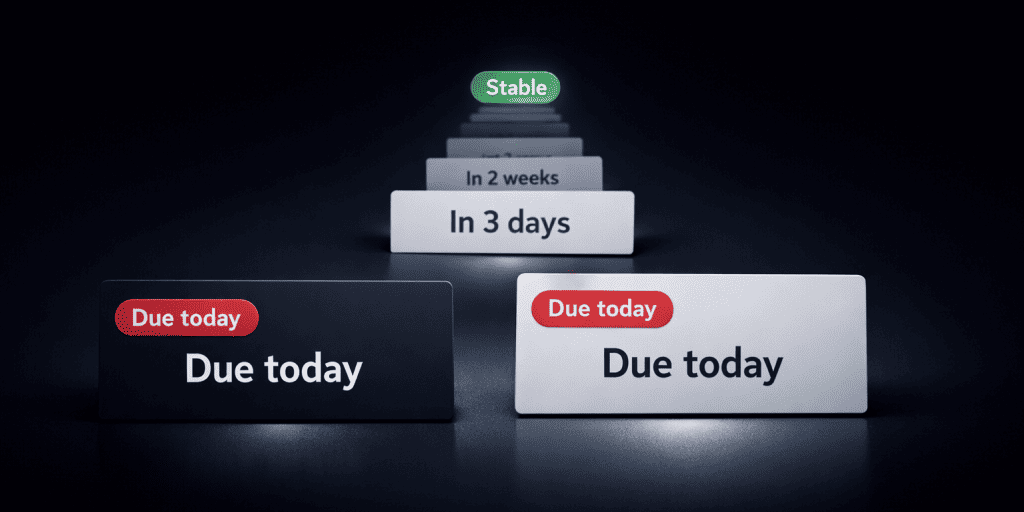
The problem is that new words are only half of the story. Every word you add today also creates review work for your future self. With spaced repetition, those reviews are cleverly spaced, but they still have to be done.
So if you only think about how many words to add and ignore the reviews they create, you can accidentally build yourself a small memory disaster:
- first week: feels great, loads of new words, almost no reviews;
- third week: you spend all your time trying to keep up with review cards;
- fifth week: you are tired, your “streak” breaks, and your beautiful plan collapses.
Before you choose a number, you need a plan that you can live with.
2. The real answer: a range, not a magic number
You will see all sorts of claims online: “serious learners do 50 new words a day”, “polyglots do 100”, “10 is for lazy people”.
In reality, the best range for most learners with work, studies and family is usually:
- 10 new words per day if you want something very light and sustainable;
- 20 new words per day if you can give the language some focused attention;
- 30 new words per day only if your reviews are already under control and you are willing to protect time for them.
All three plans can work. The difference is in:
- how much free time you have;
- how tired you are after work or studies;
- how hard your target language is for you;
- and how much mental energy you want to invest.
Let us look at each plan more closely.
2.1. Ten words per day: gentle and very sustainable
Ten new words per day sounds small, but do the basic maths:
- 10 words per day
- × 6 days per week (one day off for life happening)
- × 50 weeks per year
That is around 3,000 new words in a year.
Three thousand well-learnt words with audio, examples and active recall is not “slow progress”. It is the difference between basic survival and actually understanding films, podcasts and everyday conversation.
This pace is ideal if:
- you are a beginner and everything is still new;
- you have a stressful job or small children;
- you are fighting to build a stable daily habit.
With ten words a day, your review load stays light, and you have more time to listen, repeat and actually feel each word, not just tick it off.
2.2. Twenty words per day: strong progress for most learners
For many people, twenty new words per day is the sweet spot:
- enough to see fast progress;
- still manageable if your review system is doing its job;
- a good balance between “new” and “old” cards in your daily session.
With twenty, you need to take reviews seriously. You cannot just throw in new words every day and hope for the best. You need spaced repetition to schedule reviews and protect your memory from the forgetting curve.
This pace is realistic if:
- you already have a small daily habit;
- you can find 20–30 focused minutes most days;
- you are comfortable saying the words aloud, not just reading them.
2.3. Thirty words per day: ambitious pace with conditions
Thirty new words per day can be powerful in short bursts, but only if:
- your review sessions are already under control;
- you are using proper spaced repetition;
- you are ready to cut the number down if your review queue explodes.
At this pace, quality matters even more. If you are adding thirty words per day with no audio, no example sentences and no active recall, you are mostly feeding your passive vocabulary on paper.
If you are adding thirty words per day with audio, context, active recall and a good SRS, you are running a demanding but effective programme. You just need to watch your energy and not force yourself to keep thirty if your life does not support it.
3. What really decides your ideal daily word goal
Instead of asking “what number is correct”, ask: “what number can I sustain for at least a month without hating my life?”
Key factors:
Time per day
- How many honest minutes can you give your language on a bad day, not on a perfect one? If the answer is “ten minutes”, ten new words is already brave.
Your level
- Beginners are slower because every word feels heavy.
- Intermediate learners often speed up because they already know similar words.
- Advanced learners choose narrower, more specialised vocabulary, which can be harder again.
Language distance
- If your native language is close to the one you are learning, you can often handle more words (for example, Spanish for a Portuguese speaker). If it is far (for example, Japanese for an English speaker), fewer words with more attention usually win.
Review discipline
- If you regularly clear your review cards, you can increase your daily new words sooner. If your review queue is a mess, adding more new cards will only create guilt.
Your brain and your life
- Some people simply like dense sessions; others burn out quickly. You know yourself better than any “perfect” number you see on the internet.
4. How spaced repetition changes the numbers
Without spaced repetition, there is not much point counting new words per day. You will simply forget most of them after a week.
With spaced repetition, your daily word goal becomes a lever. You are not just dumping words into short-term memory; you are feeding a system that:
- shows new words again after minutes, hours, days and weeks;
- focuses your time on words you struggle with;
- reduces reviews for words that are already strong.
This means:
- if your reviews feel too light and you are bored, increase your new words slightly;
- if your review queue feels like a mountain every day, reduce your new words for a week.
In My Lingua Cards, the spaced repetition engine tracks every word and decides when to show it again, so your main job is to choose a reasonable daily “new word” ceiling and actually turn up for your reviews.
5. Quality over quantity: audio, context and active use
You can always push your number higher if you reduce the quality of learning. But you will pay for that later when you try to listen and speak.
A “real” word in your vocabulary should not be just spelling plus translation. Ideally you have:
- correct pronunciation from audio;
- at least one clear example sentence;
- a quick mental image or situation;
- some practice saying it aloud.
That is why ten high-quality words per day with audio and examples can easily beat thirty dry dictionary items. Your brain stores sound patterns more naturally than written symbols, so learning vocabulary with audio from day one gives you cleaner pronunciation and better listening skills with fewer total reviews.
6. From passive to active: it is not just about counting words
Another trap: counting words that you recognise as words that you can use.
You might be able to understand a thousand words when you read or listen, but only use two hundred when you speak. This is the classic gap between passive and active vocabulary.
To move a word from passive to active, you need more than just many “seen it” reviews. You need:
- deliberate practice in both directions:
- target language to native language for understanding;
- native language to target language for recall;
- speaking the word aloud, not just reading it on the screen;
- several successful recall attempts over time.
In My Lingua Cards, this is built in:
- first you see cards mostly in the target-to-native direction, building strong understanding;
- only after several repetitions does the system unlock the reverse direction on the native-language page;
- there you see the meaning in your language and must produce the word in the target language, ideally aloud.
So your daily word plan should not only ask “how many new words per day” but also “how many words per day will I actually say with my own mouth?”
7. How My Lingua Cards supports 10 / 20 / 30 word plans
Inside My Lingua Cards, those “10 / 20 / 30 words a day” plans are not just slogans. They translate into a concrete daily rhythm:
- You open the app, and it shows you cards that are scheduled for review today by the spaced repetition system.
- You work through those first. This protects your memory and stops the review pile from becoming scary.
- Only after, or mixed in with reviews, you add a small batch of new words for the day: 10, 20 or 30, depending on your plan.
Each word comes with:
- clear native audio for the main word;
- audio for Description and Example fields, so you hear it in isolation and in context;
- translations and example translations to connect meaning;
- a two-page flow (target-language page and native-language page) that gradually pushes you from recognition to active production.
The result:
- your ten-word plan feels light but solid;
- your twenty-word plan feels like serious daily training;
- your thirty-word plan is demanding but still realistic if your life allows it.
8. How to choose your starting pace inside My Lingua Cards
Here is a simple way to choose your daily word goal without overthinking it.
Step 1. Be brutally honest about your life
Ask yourself: on a bad, annoying weekday, how much energy do I have for language?
- If the answer is “I can do five minutes if you push me”, start with 10 new words per day.
- If the answer is “I can usually manage 20–30 minutes”, you can try 20 new words per day.
- Only if the answer is “I already have a steady habit and I want to push” consider 30 new words per day.
Step 2. Use a two-week experiment
Whatever number you choose, treat the first two weeks as an experiment:
- Set your daily new word ceiling in your head: 10, 20 or 30.
- Every day, first clear your scheduled reviews in My Lingua Cards.
- Then add up to your chosen number of new words, with audio and examples.
After two weeks, ask three questions:
- Am I staying on top of reviews most days?
- Do I still say the words aloud and listen to audio, or am I rushing?
- Do I feel tired or energised after sessions?
If reviews are exploding or you hate opening the app, lower your number for the next two weeks. If everything feels fine and reviews are light, you can try raising it slightly.
Step 3. Protect your minimum, not your maximum
Instead of obsessing about “30 words a day, no excuses”, decide on:
- a minimum you will protect even on bad days (for example, 10 new words);
- a maximum that you will not cross even if you feel excited (for example, 20).
This way, you build consistency first and speed second. Consistency is what actually wins in language learning; even the best spaced repetition system cannot help if you do not show up.
9. Small challenges you can start today
You do not need a perfect plan to begin. You can start with one small challenge:
- Pick your number for the next seven days: 10, 20 or 30 new words per day.
- Log in to My Lingua Cards once a day.
- First, clear your reviews for the day.
- Then add your chosen number of new words with audio and examples. Say each word aloud at least once.
After a week, look at how you feel and adjust the number. No guilt, no drama. Just a bit of honest data from your real life.
If you repeat these simple seven-day experiments a few times, you will quickly discover your personal “comfortable speed” – the pace that stretches you without snapping you.
If you want to test your own 10 / 20 / 30 word plan without building a system from scratch, My Lingua Cards is designed for exactly this kind of daily routine. You can add new words with clear audio, see them again with smart spaced repetition, and practise both directions – from the language you are learning into your native language and back again. Try setting yourself a small challenge: for the next couple of weeks, open My Lingua Cards once a day, clear your reviews and add a handful of new words. Let the app handle the timings while you focus on actually hearing, saying and remembering the vocabulary that matters to you.