You can know grammar and still get stuck. You know the tense, you know the word order, you even know what you want to say… and then your brain offers you exactly nothing when you need a basic word.
That’s why I treat “build vocabulary” as its own project. Not a vague side effect of watching videos, not a guilty extra after a grammar lesson. A separate process with its own tools, its own routine, and clear feedback.
Why grammar alone doesn’t get you talking
Grammar is a map. Vocabulary is the road.
In real conversation, you don’t have time to run grammar rules like a calculator. You mostly rely on habits and patterns. Grammar helps those patterns stay clean. But the engine of speech is still words and chunks.
A very normal situation looks like this:
You want to say: “I booked a table.”
You know past simple. You know where the verb goes. You might even remember the phrase “a table”. But the verb “to book” is missing, so the whole sentence collapses. Perfect grammar with no verb is like a beautifully wrapped empty box.
If you’ve ever thought, “I understand everything but I can’t speak”, this is often what’s happening. Your passive knowledge is ahead of your active retrieval.
What “vocabulary in your head” actually means
People talk about “knowing” a word as if it’s a yes-or-no checkbox. In practice, your vocabulary has levels.
- Passive vocabulary is what you recognise when you read or hear it.
- Active vocabulary is what you can pull out fast enough to use while you’re thinking about meaning, not language.
Most learners build passive vocabulary much faster than active. It’s not a character flaw. It’s how memory works.
And this is the key: your “in-your-head dictionary” isn’t a list. It’s a set of retrieval paths. You don’t just store “book = reserve”. You store cues that help you find the word quickly.
- The sound of the word.
- A typical sentence it lives in.
- A situation where you used it.
- A contrast with a similar word.
- A short explanation that stops you using it wrong.
The moment you can retrieve the word without a long search, it becomes usable.
Repetition is not boring, it’s the mechanism
If you want words to show up in speech, they need repetitions spaced over time.
Cramming is the classic trap. You can look at a list for 20 minutes, feel productive, and then forget half of it tomorrow. That doesn’t mean you’re “bad at languages”. It means your brain didn’t get the signal that this information matters long-term.
A useful repetition does two things:
- It forces you to recall, not just recognise.
- It happens again before the memory fully fades, so it gets reinforced.
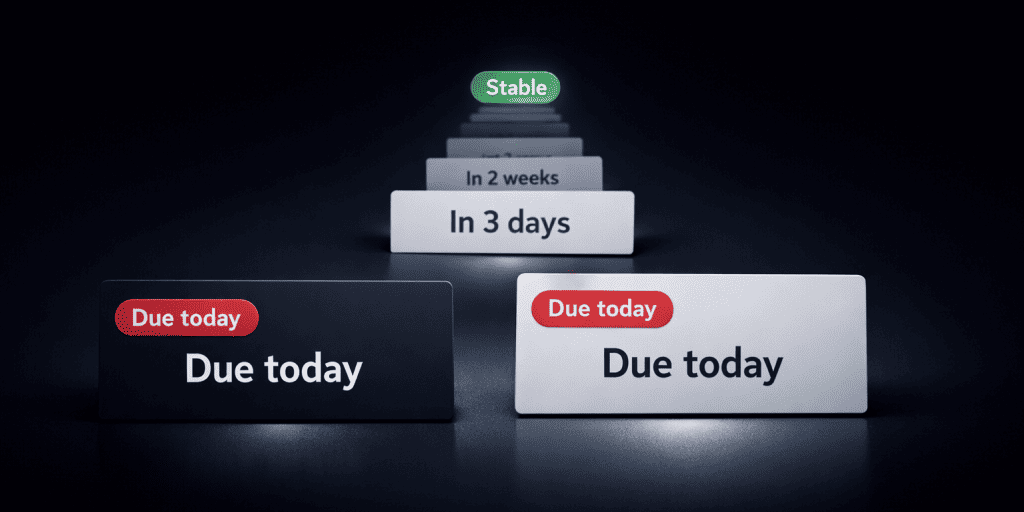
This is exactly why spaced repetition exists. The point is not to repeat a word fifty times today. The point is to repeat it a sensible number of times across days and weeks, with growing intervals, so it becomes stable.
Why word lists feel effective and still fail you
Word lists are popular because they are simple. Write words down, highlight them, feel like you’ve “covered” a topic.
The problem is that lists mostly train recognition, not recall. You look at a word, then you look at its translation. Your brain is good at pretending this is learning.
Lists also have practical issues:
- No built-in schedule, so you either forget to review or you review everything at once.
- No pressure to produce the word, so active vocabulary doesn’t grow.
- Often no audio, so the word stays “silent” in your head and is harder to recognise in speech.
- Weak context, so you know what the word “means” but not how to use it.
Lists are not evil. They’re just not designed for building a working vocabulary that appears on demand.
Why flashcards are more convenient than lists
In my view, flashcards win because they turn vocabulary into tiny, repeatable actions.
A good flashcard is not a dictionary entry. It’s a prompt that makes you try, fail, adjust, and try again at the right moments.
Flashcards help because:
- They train active recall: you attempt the answer before you see it.
- They create a routine: you can do them in short sessions without “preparing”.
- They work with spacing: the system can bring a card back when you’re about to forget.
- They scale: you can add a few words every day and still keep the workload stable.
- They are measurable: you see what sticks and what doesn’t.
And when flashcards include audio and example sentences, you’re not learning a “translation”. You’re learning a usable piece of language.
What a good vocabulary card looks like
If you want vocabulary to become speech, the card has to support more than meaning.
At minimum, you want:
- The word or phrase in the language you’re learning.
- Pronunciation support, including audio and transcription.
- A clear, short explanation of meaning, plus a fuller explanation when needed.
- Translation into your native language, with context in mind.
- One or more example sentences, plus usage notes when helpful.
Optional extras can make a difference too:
- A mnemonic to give your brain a hook.
- An image for a quick visual anchor.
This is the difference between “I saw this word once” and “I can use it”.
The missing piece: practise in both directions
If you only ever practise from the target language to your native language, you mostly build recognition.
That’s useful, but it’s not enough for speaking.
To speak, you need the reverse direction too: you see the meaning in your native language and you produce the word or phrase in the language you’re learning. That’s the moment your brain learns to retrieve.
A practical flow looks like this:
- First, you get comfortable recognising the word and understanding it.
- After enough successful repetitions, you switch on reverse practice to force active production.
- The word becomes faster, more automatic, and much more likely to appear in conversation.
If you’ve ever said “I know it, I just can’t say it”, reverse practice is usually the missing link.
How to build vocabulary as a separate, efficient process
This is where people overcomplicate things. You don’t need a new personality. You need a small daily loop.
Here’s a simple approach that stays realistic:
- Do your scheduled reviews first, before you add anything new.
- Add a small amount of new vocabulary, not a heroic pile.
- Use audio, even if it feels slower.
- Say the word out loud at least once. Yes, actually out loud.
- Keep a couple of example sentences you understand and would genuinely use.
If you want numbers that don’t melt your brain, a light plan like 10–20 new cards a day can work well if you keep up with reviews. The “secret” is not the number. The secret is consistency plus spacing.
Using AI the right way (without lying to yourself)
AI is brilliant for practice and support. It can:
- Give you more example sentences in a style you like.
- Rephrase your sentence so it sounds more natural.
- Run a short roleplay based on your topic.
- Point out repeated mistakes you keep making.
But AI does not replace the act of memorising vocabulary. You still need the word to be in your memory, available quickly, or you won’t use it when it counts.
The healthiest way to think about it is:
- Flashcards and spaced repetition build the storage and retrieval.
- AI makes the usage feel real and keeps practice flexible.
Use AI as a gym for output, not as a magic hard drive.
Common mistakes that quietly kill your progress
These are the patterns I see over and over:
- Adding too many new words and then drowning in reviews.
- Skipping audio because it feels optional, then struggling to understand real speech later.
- Only learning single words and ignoring phrases, then speaking in unnatural fragments.
- Keeping vocabulary passive only, then wondering why speaking doesn’t improve.
- Treating “I recognised it” as “I know it”, then being shocked when it vanishes in conversation.
If you fix just one thing, fix this: stop measuring vocabulary by recognition. Measure it by retrieval.
What you can do today
Pick a tiny action you’ll actually do, not a fantasy routine.
- Choose one topic you talk about in real life and learn 10 useful words or phrases for it.
- For each new item, add at least one example sentence you understand.
- Listen to the audio and repeat it once out loud.
- Review yesterday’s cards before you add anything new.
- Do a short reverse practice session from your native language to the target language.
Even one week of this done properly feels different. Words start showing up without you dragging them out by force.
A simple way to do this in My Lingua Cards
If you want vocabulary to be a clean, separate process, My Lingua Cards is built around that workflow. You get ready-made sets of words and phrases, then train them with smart cards that include audio, transcription, translations, explanations, and example sentences. The spaced repetition system decides what to show you today, so you spend time recalling, not organising.
When you’ve done enough successful repetitions, you can practise in the reverse direction too, so words stop being “recognised-only” and start becoming usable. And if you want a controlled way to practise in a more conversational format, there’s also an AI chat mode inside the service. You can start with the free period and try it with up to 200 vocabulary cards, then keep going if the routine clicks.