You learn a list of new words, feel proud of yourself… and a week later most of them have vanished. It feels like your brain is working against you. In a way, it is – but in a very predictable, scientific way.
That pattern has a name: the Ebbinghaus Forgetting Curve. Once you understand it, you can use it to your advantage instead of fighting it.
In this article, I will explain the forgetting curve in simple terms and show how My Lingua Cards quietly uses it in the background to bring back your words right on the edge of being forgotten.
What is the Ebbinghaus Forgetting Curve?
In the nineteenth century, a German psychologist called Hermann Ebbinghaus ran experiments on how quickly people forget new information. He discovered something uncomfortable but very useful:
- After about 20 minutes, you may already forget around 40% of what you learned.
- After one day, you can lose about 70%.
- After six days, you have usually forgotten most of it unless you reviewed it.
If you draw this on a graph, it looks like a steep slide down. At first you remember a lot. Then your memory drops very fast. This shape is the forgetting curve.
Your brain is not being lazy. It is trying to save energy. If you do not use information, your brain decides it is not important and throws it out.
Why this hits language learners so hard
Vocabulary is especially vulnerable to the forgetting curve:
- You learn ten new words in the evening.
- The next day, a few are missing.
- A week later, only one or two still feel familiar.
If you only “cram” words – repeat them many times in one sitting and then move on – you mostly feed your short-term memory. The forgetting curve then wipes out your hard work over the next few days.
This is why so many learners say things like:
- “I studied for hours, but nothing sticks.”
- “I recognise the word, but I cannot recall it when I speak.”
The problem is not you. The problem is how the brain handles unused information.
The simple trick: interrupt the curve at the right time
The good news: the forgetting curve is not fixed. Every well-timed review lifts it up again. If you look at a word just before you are about to forget it, your brain gets a strong signal:
“Oh, we are using this again. Keep it.”
This idea is the basis of spaced repetition – a method where you review information at smart, growing intervals instead of repeating it twenty times in a row.
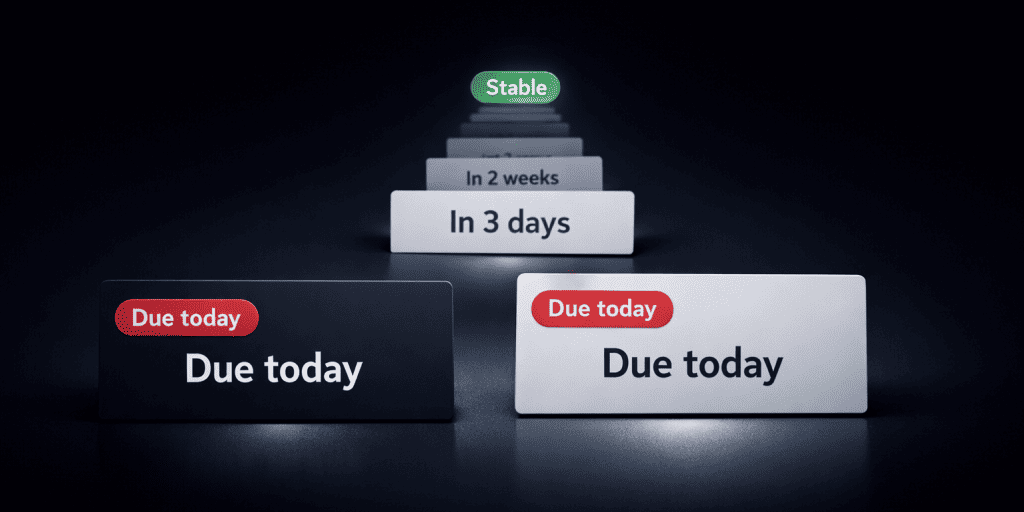
A typical pattern for a new word might look like this:
- first review: a few minutes after you learn it
- second review: a couple of hours later
- third review: the next day
- then after 3 days, 7 days, 2 weeks, 1 month…
Each time you remember the word, the gap before the next review becomes longer. If you forget it, the system brings it back sooner.
Instead of one big, tiring session, you get short, targeted reviews that tell your brain: “this word really matters, do not delete it”.
Why paper flashcards struggle with this
You can try to copy this by hand with paper flashcards and little boxes for “review in 1 day”, “review in 3 days” and so on. Some people do this, but it is messy:
- You must calculate all the dates yourself.
- You shuffle cards around all the time.
- The system breaks as soon as life gets busy.
On top of that, paper cards usually have no audio, so you are only training your eyes, not your ears and pronunciation.
In my view, this is where digital tools have a huge natural advantage.
How My Lingua Cards uses the forgetting curve for you
My Lingua Cards is built around spaced repetition, not as an extra feature but as the core engine. You do not have to think about dates, intervals or boxes. You just log in and review what is scheduled today.
Here is what happens behind the scenes:
1. The system tracks every word separately
For each word, My Lingua Cards keeps a mini-history of how you performed:
- Did you remember it easily?
- Did you hesitate?
- Did you forget it completely?
If you know a word well, the next review is pushed further into the future. If you struggle, it comes back sooner. You spend most of your time on words that are actually at risk of being forgotten.
2. Words appear right on the edge of forgetting
The aim is simple: show you the word just before it disappears from your memory.
From your side this feels almost magical:
- A word you have not seen for a while pops up.
- You think, “Oh yes, I know this… just about.”
- You successfully recall it – and the memory becomes much stronger.
This is exactly the sweet spot where the forgetting curve is about to drop, and the review pulls it back up. My Lingua Cards is constantly adjusting these moments for every single word you learn.
3. Audio turns each review into mini listening practice
Every card in My Lingua Cards comes with clear native audio. When you tap to hear the word, you are not just revising; you are also training your ear and your pronunciation at the same time.
You build a memory that connects:
- sound
- meaning
- spelling
This kind of multi-sensory memory is more stable and needs fewer total reviews to stick for the long term.
4. Two directions: from “I recognise it” to “I can say it”
Remembering a word when you see it is not the same as producing it when you speak. That is why My Lingua Cards trains both directions:
- Target language to native language: you see the foreign word and understand it.
- Native language to target language: you see the meaning and must say the foreign word yourself.
Cards only unlock the second direction after several successful reviews in the first direction. In practice, this means the app waits until the word is strong enough in your passive memory before asking you to actively produce it.
From an Ebbinghaus point of view, this is very sensible: you first stabilise the memory with spaced repetition, then you start stretching it by speaking.
What you should actually do day to day
You do not need to understand the maths behind the forgetting curve to benefit from it. A simple routine is enough:
Open My Lingua Cards once or twice a day.
Clear the cards that are due for today. Trust that the system is choosing them for a reason.
When you see a card:
- Look at the front.
- Say the answer aloud before you flip it.
- Listen to the audio and copy the pronunciation.
You do not need marathon sessions. Often 10–20 minutes a day is enough, as long as you keep coming back. Short, regular sessions work far better with spaced repetition than rare, long ones.
Light call to action: let the system remember the timing for you
If you are tired of learning the same words again and again, the real problem is not your willpower. It is that you are revising them at the wrong times.
The Ebbinghaus Forgetting Curve explains why this happens. Spaced repetition is the fix. And My Lingua Cards is designed to do the timing for you:
- it tracks your words,
- surfaces them right on the edge of forgetting,
- and combines this with audio, examples and two-way practice so you can actually use them.
If you want to see how this feels in real life, create a free account on mylinguacards.com and try clearing your scheduled cards for a few days in a row. Pay attention to how often “almost forgotten” words suddenly feel solid again.
That is the forgetting curve working for you, not against you.
.png)